A Principled Technologies report: In-depth research. Real-world value.
Cloud platform comparison: HPE Private Cloud vs. Dell Private Cloud
Virtualization licensing changes and AI data gravity are prompting many IT leaders to rethink their private cloud strategies. Businesses face numerous challenges, including balancing scalability, security, cost efficiency, and integration with existing infrastructure. Navigating these complexities requires careful evaluation of available solutions to ensure that the chosen platform aligns with both current needs and future growth.
In this study, which uses public source materials, we present a comparative analysis of two prominent private cloud platforms: HPE Private Cloud PC3000 with Morpheus Enterprise and OpsRamp compared to Dell™ Private Cloud with Dell Automation Platform. By examining these solutions, including their approaches, features, and overall value, we aim to provide insights that will assist businesses in making informed decisions about their cloud strategy.
Simplify migration from VMware with built-in tooling
Save on licensing costs with per-socket hypervisor pricing
Get more insights from top to bottom with AIOps from HPE
Streamline management with a unified, single-pane-of-glass console for VM and application management
Summary of findings
Gain the advantages of a mature, unified private cloud solution with HPE Private Cloud
The HPE solution covers Day 0 through Day 2 for HPE infrastructure and unifies VM management across HPE HVM or VMware® ESXi™
Morpheus Enterprise adds universal governance and FinOps, along with multi-hypervisor and multi-cloud control
HPE simplifies management with unified controls rather than with multiple third-party add-ons
Lower your TCO with per-socket pricing for native hypervisor HPE HVM
Per-socket subscription model with VM Essentials can cut virtualization licensing costs by up to 91% compared to VMware-based environments1
Support for brownfield hardware allows organizations to transition to this ecosystem without a mandatory hardware refresh, significantly reducing the solution’s initial expense
Automate hypervisor conversion with built-in tools
Simplify the path to per-socket hypervisor license savings with built-in VM Essentials Migration Tool
Upgrading to HPE Morpheus Enterprise expands the Morpheus console to include other cloud options, including Nutanix®, Red Hat® OpenShift®, and major public clouds
Note: We conducted our research from April 1st to April 30th 2026, before HPE rebranded HPE Private Cloud Business Edition (PCBE) as HPE Private Cloud PC3000. Any sources citing Private Cloud Business Edition apply to what is now called HPE Private Cloud PC3000.
Introduction
This paper compares two different vendor approaches to delivering a modern on-premises private cloud: HPE Private Cloud, with HPE Morpheus Enterprise and HPE OpsRamp upgrades, versus Dell Private Cloud with Dell Automation Platform. Both solutions disaggregate compute, storage, and networking at the hardware layer, and both ship with validated, blueprint- or catalog-driven deployment tooling. They diverge sharply, however, in how much of the stack each vendor includes, and in where day-to-day workload management lives.
In this study, we evaluate the two solutions across six dimensions: platform maturity, cost efficiency and TCO, mixed workload support, flexibility for a VMware transition, architecture and integration, and lifecycle management and fleet operations.
The solutions
HPE ships Private Cloud as an engineered system that includes a predefined hardware stack, a lifecycle management console, and HPE Morpheus VM Essentials (VME). VME provides virtualization management as well as a KVM-based hypervisor (HVM). Customers can run either HVM or VMware ESXi virtualization software on the HPE Private Cloud cluster. HPE Private Cloud includes an HVM subscription, but customers must provide the VMware subscription. Administrators can use the VME console to manage either the VMware or HVM VMs, and then use the HPE Private Cloud console to handle the lifecycle management of the hardware stack.
HPE Morpheus Enterprise is a cloud management platform (CMP) that extends the VME console by adding full cloud management capabilities that offer a unified control plane across both private (Red Hat, Nutanix, etc.) and public (Amazon Web Services [AWS], Azure, etc.) clouds for catalog-driven self-service, governance, multitenancy, and FinOps. Native support for Kubernetes is also included with HPE Kubernetes Service (HKS). Finally, HPE OpsRamp handles cross-stack observability for HPE Private Cloud as well as for over 3,000 device models—from both HPE and other vendors—spanning network, storage, and server categories.
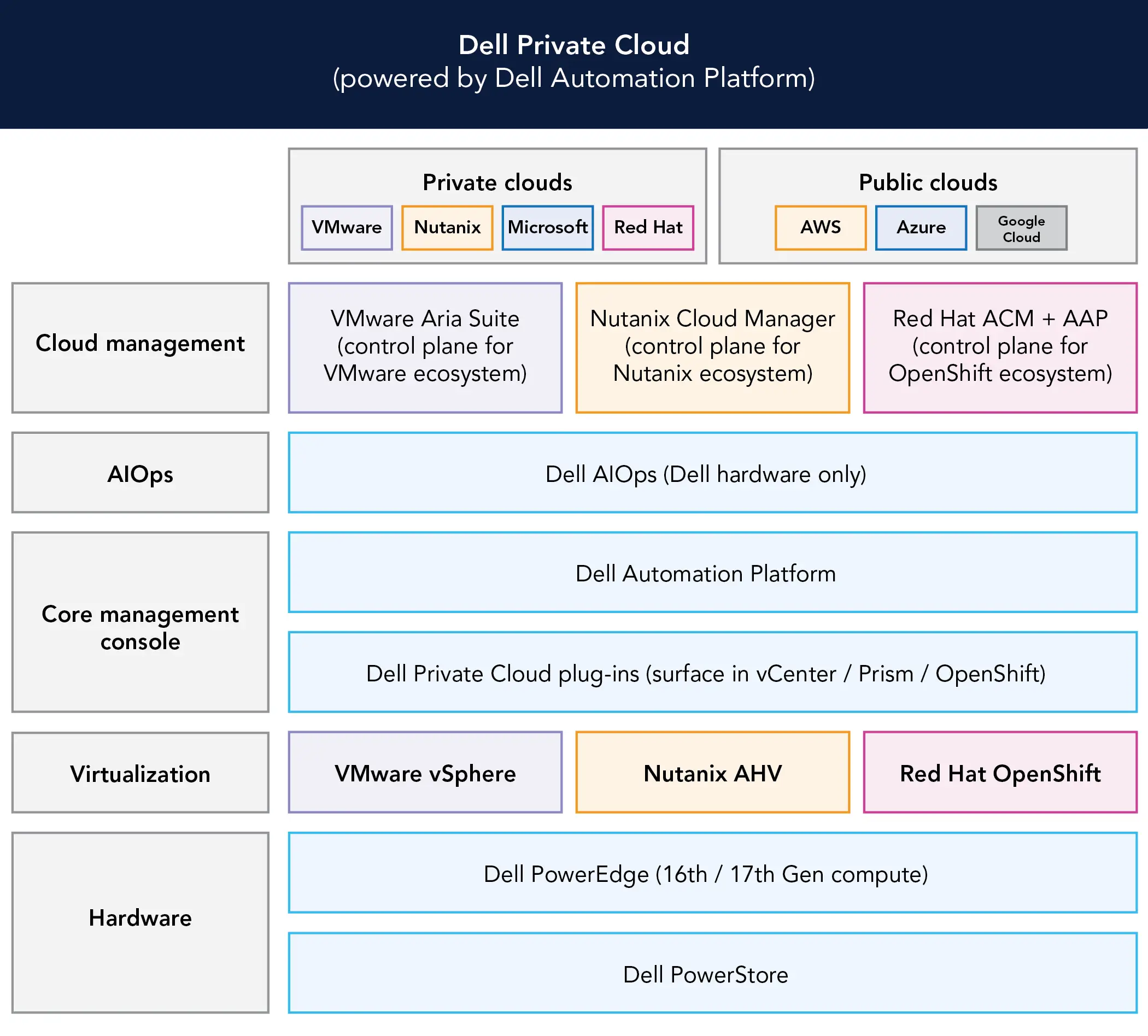
Dell ships Dell Private Cloud as a validated cluster that includes the customer’s choice of third-party hypervisors. The customer must provide all hypervisor licenses. Dell Automation Platform (DAP) automates supported third-party stack deployment (VMware vSphere®, Red Hat OpenShift, Nutanix AHV®) on Dell PowerEdge™ servers and Dell storage. DAP also contains blueprints for cluster management tasks such as adding and removing nodes. Once deployed, workload-level management and some cluster lifecycle management tasks, including full stack updates, take place inside each third-party stack’s native tooling. A Dell Private Cloud plug-in surfaces hardware views and lifecycle actions inside those native consoles (e.g., VMware vCenter®, Nutanix Prism®, OpenShift). Dell offers Dell AIOps (bundled with Dell ProSupport™) for Dell hardware only. All hybrid cross-stack cloud functions such as management, FinOps, or catalog-driven user self-service are left to third-party cloud management platforms such as VMware Aria Universal Suite™. Figures 1 and 2 show each vendor’s approach.
HPE Private Cloud plus Morpheus Enterprise and OpsRamp elements (in green).
The Dell Private Cloud powered by Dell Automation Platform component stack (in blue). Hybrid cloud management is available by implementing discrete third-party CMP solutions. This differs from the HPE unified cloud management approach where a single tool (HPE Morpheus) can manage a wide variety of private and public clouds.
Platform maturity
In this section, we assess the platform maturity of the two solutions, including their completeness and operational status for Day 0 through Day 2 operations. We evaluate solution history, depth of feature coverage, ecosystem breadth, and available reference architectures.
HPE Private Cloud
HPE Private Cloud, introduced in 2019 and currently on its fourth generation, is an engineered, pre-integrated private cloud platform built on HPE-owned infrastructure, hypervisor, and management components. HPE designed these components to function together as a single product, rather than requiring customers to independently source and validate compatible components.2 This integrated approach defines the platform’s maturity across Day 0 through Day 2 operations.
At Day 0, HPE Private Cloud includes HPE-delivered deployment services covering the initial setup of the service in three phases: 1) a transition phase that assigns the HPE delivery resource and coordinates logistics and scheduling ahead of delivery, 2) an implementation phase that provides physical installation at a customer data center or HPE GreenLake colocation facility, and 3) an onboarding phase that configures metering tools to monitor consumption and provide data to the hybrid cloud portal.3 Smart Templates provide pre-defined systems with storage, compute, and network components tuned for different workload types, while allowing customization of server model, CPU, memory, and storage configuration. This gives customers a starting point without requiring them to independently determine compatible components.4
From Day 1, the HPE Private Cloud and VME solution provides users with a unified view of VM inventory, infrastructure health, cluster status, and provisioning for both on-premises VMware workloads and workloads running on HVM. VMware management is available via a vCenter integration from the same VME interface.5 The dashboard spans VMs and clusters and details capacity trends, performance details, alerts, audit logging, and task status. The same console offers VM provisioning for both hypervisors, without requiring administrators to access separate management platforms.6
At Day 2, HPE Private Cloud provides full stack lifecycle management through automated catalog-based updates covering hardware, software, and firmware components. The console provides performance data, capacity details, and alerts as well as HPE Alletra Storage MP features, snapshots, replication, uptime guarantees, and more.7 Routine health checks and single-click upgrades are available across the environment.8
HPE Morpheus Enterprise transforms HPE Private Cloud into a full hybrid cloud management platform. Governance capabilities include role-based access control (RBAC) with dozens of configurable policies, SSO integration with corporate identity providers, multitenancy to segregate team and user access across environments, secrets management, and activity auditing.9 FinOps capabilities include cross-cloud cost discovery and inventory, budget guardrails, sizing recommendations, chargeback and showback reporting, and cost allocation. Morpheus Enterprise extends management to major private clouds (Nutanix AHV, Microsoft Hyper-V, Red Hat OpenShift) and to major public clouds, (Google Cloud, AWS, Microsoft Azure, OCI), and includes support for both VM- and Kubernetes-based container workloads.
HPE OpsRamp adds Day 2 observability and operational intelligence across the full hybrid cloud environment. It automatically discovers and monitors VMs, containers, applications, and infrastructure regardless of the underlying hypervisor or cloud provider, consolidating health and performance data across all targets in a single platform. It supports over 3,000 integrations across multi-vendor infrastructure and tooling, extending well beyond an on-premises HPE environment.10 This infrastructure would fall outside of the purview of the HPE Private Cloud ecosystem, but could still provide value if an org has a non-HPE cluster they want to keep tabs on within a single observation window/along with the Private Cloud hardware.
Dell Private Cloud
Dell Private Cloud, generally available in late 2025, handles standardized deployment and environment instantiation. Dell Automation Platform provides Dell-curated, validated blueprints that automate the provisioning of supported private cloud environments on Dell infrastructure.11 These blueprints encapsulate tested combinations of hardware, software, firmware, and configuration,12 enabling automated deployment of VMware vSphere, Red Hat OpenShift,13 and Nutanix AHV14 private cloud environments. The Dell solution is characterized by a defined deployment model built on blueprint-driven automation, validated architectures and configurations for deploying supported private clouds on Dell infrastructure, and coupling to Dell infrastructure lifecycle management workflows and validation processes.15
Once a private cloud stack is deployed, Dell Private Cloud establishes operational boundaries between infrastructure management and workload-level operations. Day 1 activities such as workload provisioning, access management, and governance and policy enforcement reside primarily within the ecosystem-native tooling for each deployed private cloud.16,17 Dell Automation Platform provides limited blueprint-based automation for common infrastructure-adjacent processes—such as standardized VM deployment or cluster-level lifecycle operations tied to deployment and infrastructure changes18—but its primary role is providing fleet-level visibility and lifecycle management for the Dell Private Cloud hardware inventory rather than a centralized VM or workload control plane.
Dell Automation Platform extends blueprint-driven automation into Day 2 operations through firmware update orchestration, cluster-level operations such as node additions or removals, compatibility enforcement, and infrastructure-level lifecycle coordination across the Dell-managed hardware fleet.19
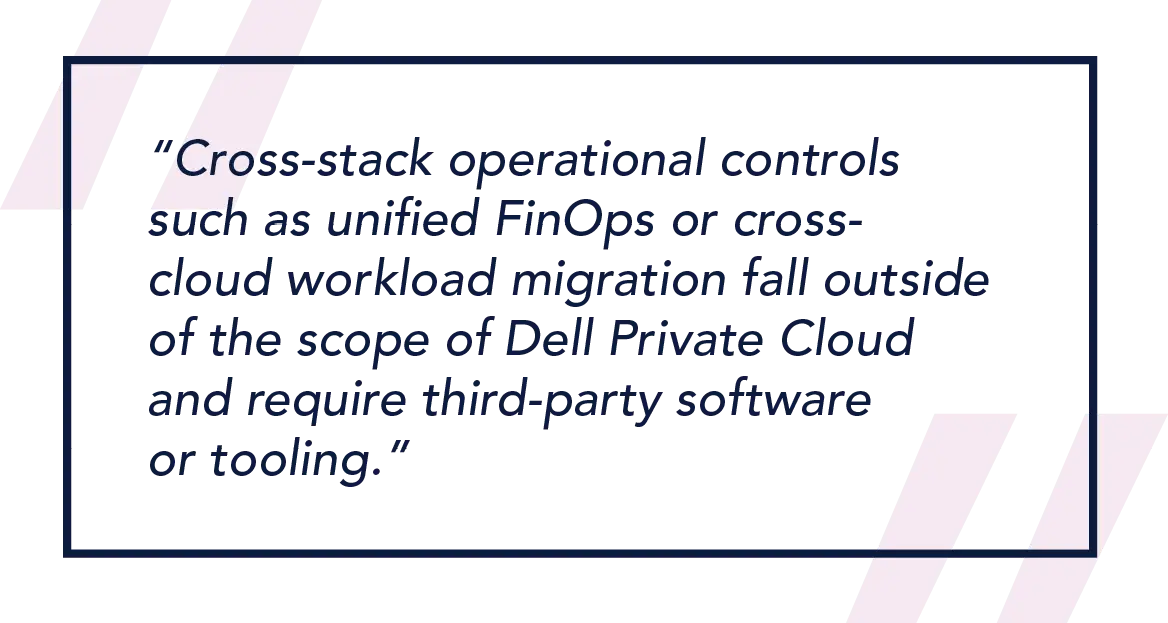
With automated infrastructure lifecycle workflows aligned to Dell support and validation models, coordinated update and maintenance processes to keep deployed environments in a supported state, and fleet-level visibility,20 the infrastructure-centric nature leaves other Day 1 and Day 2 operations under the purview of their respective cloud-native tooling, such as VMware vCenter, Nutanix Prism, Red Hat OpenShift Web Console. This includes most aspects of workload lifecycle management, RBAC, policy enforcement, platform-level optimization, and governance. Cross-stack operational controls such as unified FinOps or cross-cloud workload migration fall outside of the scope of Dell Private Cloud and require third-party software or tooling. As such, Dell Private Cloud’s platform maturity is strongest where Dell owns the control surface—deployment, validation, and infrastructure lifecycle—and is intentionally constrained where third-party ecosystems define and own the operational model.
Our conclusions
Both HPE and Dell solutions show platform maturity, but from different perspectives. Dell Private Cloud is a relatively new offering, but it sits on top of Dell infrastructure automation tooling and the mature third-party stacks it deploys. The product has depth, but within a narrow lane: blueprint-driven deployment, infrastructure lifecycle management, validation workflows, and fleet visibility across Dell hardware. It deliberately stops at the infrastructure boundary, leaving workload operations, governance, and FinOps to each deployed stack’s native tooling or to third-party products the customer must source and integrate separately.
The HPE solution’s maturity extends across more of the stack. HPE Private Cloud covers Day 0 through Day 2 for HPE infrastructure and unifies VM management across HVM or VMware. Morpheus Enterprise adds production-grade governance (RBAC, SSO, multi-tenancy, secrets management, auditing) and FinOps (cost discovery, budget guardrails, chargeback, sizing recommendations), along with multi-hypervisor and multi-cloud control. OpsRamp adds cross-vendor observability. More of the operational surface is validated, documented, and supported by a single vendor.
Taken together, both vendors are in a period of active evolution, but the HPE solution stack covers materially more of what enterprises expect from a mature hybrid cloud platform, including universal governance, FinOps, multi-tenancy, cross-stack workload management, and multi-vendor observability. The HPE solution delivers these as native capabilities rather than as customer-assembled third-party add-ons.
Cost efficiency and total cost of ownership
In this section, we assess which pieces of the solutions require additional monetary investment and where organizations can reuse existing licenses. While we do not include exact prices, we do assess where a solution’s approach may save or cost money compared to other approaches.
HPE Private Cloud
The total HPE Private Cloud solution cost comes from three primary components: physical infrastructure, management software, and operational services. The hardware layer, which comprises ProLiant Gen11 or 12 compute nodes and Alletra MP B10000 storage arrays, represents the most significant variable cost and fluctuates based on specific performance and capacity requirements. Organizations can acquire this infrastructure through a traditional CAPEX purchase or a GreenLake OPEX consumption model. Under the infrastructure-as-a-service (IaaS) OPEX model, users enter a 3- or 5-year subscription with a predictable monthly fee and can upgrade to the latest hardware generations or extend the service of their current hardware at the term’s conclusion.21 Additionally, the HPE Private Cloud solution’s ability to onboard supported brownfield hardware (specifically existing Gen10 or newer ProLiant servers and Alletra storage) allows organizations to transition to this ecosystem and access its lifecycle management benefits without a mandatory hardware refresh significantly reducing the solution’s initial expense.22
HPE software leverages the per-socket subscription model established by VM Essentials (which comes bundled in Private Cloud), providing a notable architectural distinction from the more common per-core licensing structure. HPE states that in high-density configurations, this approach can result in up to 2.9 times lower total cost of ownership over 5 years, including up to 91 percent lower virtualization licensing costs compared to VMware-based environments, although actual savings vary based on workload characteristics and deployment scale.23 While HVM is now included with HPE Private Cloud, VMware vSphere requires a separate subscription.
While final solution contract pricing is largely configuration-dependent, HPE lists the VM Essentials foundation portion at approximately $600 per socket for a one-year term. For organizations requiring multi-cloud orchestration and FinOps visibility, the Morpheus Enterprise upgrade list price is $4,500 per socket per one-year term.24 Finally, the additional observability and agentic AI remediation capabilities provided by OpsRamp are available as an additional subscription fee (1-, 3-, and 5-year intervals) and scale based on the number of managed resources or overall environmental size.25 These products are all part of the HPE Private Cloud with Morpheus Enterprise and OpsRamp solution.
Dell Private Cloud
The total cost of the Dell solution depends on many factors, including the number of servers in the deployment, whether the customer is repurposing existing hardware or buying new, and if they’re able to reuse existing software licenses. While HPE Private Cloud bundles the native HVM/VM Essentials hypervisor, Dell requires licensing for the third-party hypervisor of the customer’s choice. Dell provides a list of PowerEdge servers and Dell storage that various hypervisors support. Dell Private Cloud operates under a “bring your own networking” policy, so long as it provides at least 10GbE connections.26
Dell licensing costs depend heavily on hypervisor choice. The Dell Automation Platform license is a “no-cost subscription,” but if the deployment is on-premises, the supporting management host requires licensing for the OS, etc.27 The Dell Private Cloud licenses are also subscription-based and licensed per node. Organizations can reuse these licenses as they decommission servers.28 While iDRAC and standard storage licenses are required, they do not require additional purchases.
For hypervisor software, Dell relies on customers purchasing or bringing their own. This provides flexibility for users to deploy whatever environment they need while still maintaining each stack in a manner that allows for validated lifecycle management and updates. While the exact costs will differ depending on which hypervisor(s) customers choose, these license costs can add up quickly, especially with per-core pricing from vendors like Broadcom.
Our conclusions
HPE Private Cloud offers users a cost-saving hypervisor alternative (HVM) compared to Dell Private Cloud offerings. While total costs depend on infrastructure size and performance needs, per-socket pricing is less expensive than per-core licenses. For example, a dual-socket server with 64 cores per socket would be ~$1,200 to license with HPE VME, while that same server with per core licensing and 128 total cores would be over $12,000 at even just $100 per core. So, while both Dell and HPE can reuse some third-party software licenses and existing hardware, HPE Private Cloud includes the HVM hypervisor, which can offer licensing costs savings compared to Dell Private Cloud, which requires customers to license a third-party hypervisor.
Mixed workload support
In this section, we assess how each platform runs and manages both virtual machines and containers within a unified environment, with a particular focus on simultaneous multi-hypervisor management. For instance, HPE Morpheus Enterprise can manage VMware, Nutanix, KVM, Red Hat OpenShift, and public cloud targets all within a single management plane at the same time. For the Dell solution, we outline what the customer needs to deploy, configure, or purchase to achieve an equivalent mixed-workload management capability, including whether Dell Cloud Automation Software supports concurrent management of multiple hypervisor types or requires a sequential, reprovision-and-replace approach.
HPE Private Cloud
The HPE solution supports mixed workloads through a unified visibility layer that presents VMware and HVM environments side-by-side in the VME console. VMware clusters are connected via vCenter credentials, and admins can manage HPE’s KVM-based HVM hypervisor clusters natively from the same interface. This allows administrators to view VM inventory, manage cluster health, and execute cluster lifecycle operations across both hypervisor types.29,30 HPE VME also includes a self-service catalog for users to provide easy access to spin up approved VM templates.31 Kubernetes and container workload management are available with the Morpheus Enterprise add-on. The HVM hypervisor supports native live migration, high availability (HA), and distributed workload placement, managed through the VM Essentials interface.32
HPE Morpheus Enterprise expands the unified control plane to include Nutanix AHV, Microsoft Hyper-V, Red Hat OpenShift, Google Cloud, AWS, Azure, and OCI alongside what HPE Private Cloud natively provides, extending workload management to cover VMs, Kubernetes-based container workloads, and public cloud instances from the same console. Morpheus Enterprise also adds a self-service catalog with pre-built deployment templates. This enables administrators to perform consistent workload provisioning and lifecycle management across deployments from a single console.33,34 Morpheus Enterprise also includes HKS, a CNCF-certified Kubernetes distribution.
The HPE OpsRamp upgrade adds a unified observability layer across on-premises and cloud environments. It automates discovery and monitoring of VMs, containers, applications, and infrastructure regardless of the underlying hypervisor or cloud provider, providing health and performance data across all targets in a single console. Built-in AIOps can interpret alerts, identify causes, and assist in remediation across the full mixed-workload environment.35,36
Dell Private Cloud
Dell Private Cloud supports mixed workloads through a stack-separated, multi-ecosystem model delivered via Dell Automation Platform. Rather than presenting a single logical cloud or unified workload management plane, Dell Private Cloud enables customers to deploy multiple private cloud stacks in parallel across a shared server and storage fleet. Dell Private Cloud currently supports VMware vSphere, Red Hat OpenShift, and Nutanix AHV,37 deployed through validated blueprints as operationally independent third-party private cloud stacks on Dell Private Cloud-supported infrastructure. Each stack’s native tooling manages VMs and workloads rather than via a centralized, hypervisor-agnostic control plane.
At the same time, Dell Automation Platform does provide limited cross-stack visibility and automation at the VM level. Through the Automation Platform orchestrator console, administrators can view infrastructure inventory and deployed environments, observe VM inventory across all supported stacks, and use custom blueprints to automate some common VM tasks.38 For example, you can use blueprints to deploy and configure VMs from templates or golden images to a previously deployed private cloud environment directly from the Orchestrator console, including post-provisioning configuration steps like setting credentials, hostname, and network settings. This allows Dell Automation Platform to perform some basic orchestration functions from outside of the stack-native tooling, particularly VM lifecycle tasks such as provisioning, scaling, or deprovisioning.
Dell Automation Platform provides validated blueprints for deployment, infrastructure lifecycle automation, and fleet-level coordination, but it does not replace or attempt to unify the stack-native management planes for Day 1 or Day 2 workload-specific operations such as fine-grained provisioning, governance or policy management, or ongoing application or workload-level operations. This approach preserves native workflows and tools optimized for each ecosystem that some administrators may prefer. Dell Automation Platform achieves mixed-workload support through coordinated operation of multiple private cloud stacks rather than through the unified workload abstraction.
Our conclusions
Both the HPE solution and Dell Private Cloud support environments that span multiple workload types and virtualization platforms, but with fundamentally different operating models. The HPE approach centers on a unified hypervisor and cloud-aware control plane. HPE Private Cloud and VME present on-premises VMware or HVM environments and can extend that management framework to a wide range of other hypervisors, container engines, and public cloud instances via Morpheus Enterprise. This allows IT administrators to provision workloads and manage and monitor systems from a single, centralized console across heterogeneous infrastructure.
By contrast, Dell Private Cloud supports mixed workloads through a stack-separated model that prioritizes ecosystem-specific tooling. Dell Automation Platform enables standardized and automated deployment, lifecycle management, and some basic VM orchestration functions across VMware, OpenShift, and Nutanix environments, but it does not unify those environments under a single workload management plane. Day 1 and Day 2 operational authority resides within each stack’s native tools, with Dell Automation Platform providing coordination at the infrastructure and lifecycle orchestration level rather than full workload abstraction. As such, mixed workload support in the context of Dell Private Cloud centers on parallel operation and coordination between stacks and stack-specific tooling and optimizations rather than an abstracted single logical cloud.
The HPE model favors organizations seeking consistent provisioning, governance, and observability across diverse workloads and hybrid cloud environments. The Dell model favors organizations that prioritize ecosystem fidelity and operational separation, accepting additional tooling boundaries and added complexity in exchange for preservation of existing stack-specific workflows and processes.
Flexibility for VMware transition
In this section, we assess how each solution can help customers moving away from VMware environments, including other available hypervisors, how migrations are done, and management options available for future investment.
HPE Private Cloud
The HPE solution serves as a unified management plane for HVM and VMware vSphere hypervisors. The exact functionality available in each console—HPE Private Cloud console and VME manager—will differ based on how you deploy them. Functionally, the HPE Private Cloud console controls the full-stack lifecycle management of the underlying compute and storage hardware, while the integrated Morpheus VM Essentials engine provides the virtualization control layer for both vSphere and HVM-based instances. However, in a combined environment, most of the functionality including cluster management lives within the VME console.39 The solution enables a phased migration strategy, allowing organizations to maintain legacy VMware instances for existing workloads while directing new deployments toward the KVM-based HVM layer.40 Using the Morpheus VM Essentials Migration Tool, users can automate a hypervisor-to-hypervisor transfer and conversion process to migrate VMs, bypassing the need for many manual tasks such as exporting from a cluster and image conversion. Some VMs will require additional pre- or post-migration tasks that may require manual steps.41 This is not a live migration process, so organizations must plan for application downtime during the transfer.42
The Morpheus Enterprise upgrade includes support for other platforms, including Red Hat OpenShift, Nutanix, and major public clouds. Morpheus Enterprise has capabilities that can serve as replacements for several VMware Cloud Foundation services, helping to streamline transitions from VMware to the HPE ecosystem.43 For organizations currently using the Kubernetes service within VMware, Morpheus Enterprise includes HKS, which provides support for Kubernetes and containerized workloads on the HVM hypervisor, enabling both cloud-native applications and VMs to operate within a single environment.44 Adding HPE OpsRamp provides full-stack observability along with AI-driven insights and automation features designed to support proactive management of heterogeneous cloud environments and issue remediation.45
Dell Private Cloud
Dell Private Cloud supports running Red Hat OpenShift, VMware, and Nutanix hypervisors on Dell hardware.46 With Dell Automation Platform, customers can automate a non-VMware cluster deployment on existing, prepared Dell hardware using pre-defined blueprints. They can shift their existing VMware workloads to the new cluster, and then restore their VMware servers to a clean state, ready to reprovision with a new hypervisor using Dell Automation Platform blueprints.47 With blueprints that handle removing nodes from clusters, customers can migrate VMs gradually and shift servers from a VMware cluster to new clusters.48 The migration process for those VMs depends on the migration target. Dell relies on existing third-party tools to help customers move VMs (such as Red Hat OpenShift VM migration).49 Dell Private Cloud also offers container-native solutions for customers via third-party software stacks. Customers that want to maintain AIOps after migration can use Dell AIOps, which comes with ProSupport licenses and provides automated operations, insights, and mitigation of Dell hardware.50 Additionally, if customers rely on VMware Aria software, they can find similar solutions through third-party software such as Nutanix Cloud Manager (NCM).51
Our conclusions
When migrating VMware VMs to a new environment, Dell Private Cloud allows customers to choose from Nutanix and OpenShift while relying on the native consoles for VM management and migration.
With HPE, customers using the HPE Morpheus VM Essentials console can manage both VMware and VME VMs in one place, which can help alleviate disruption. They can use the built-in tool to move VMware VMs to the new HPE hypervisor environment. However, the tool does not allow live migrations, which may create issues for some customers. Users can enable live migrations, however, through other HPE tools or third-party integrations.
Upgrading to HPE Morpheus Enterprise expands the Morpheus console to include other cloud options, including Nutanix, Red Hat OpenShift, and major public clouds. Morpheus Enterprise allows customers to expand their private cloud to full hybrid cloud management, while Dell customers would need to deploy a third-party cloud management platform.
Overall, HPE Private Cloud with Morpheus Enterprise offers a strong choice for customers looking for single-pane management for migrating VMs to various cloud platforms. Dell Private Cloud relies on various third-party tools within the virtualization stacks and could be more appropriate for customers prioritizing ecosystem fidelity.
Architecture and integration
In this section, we assess the architectural approaches of the two solutions, including the degree to which each represents an integrated engineered system versus a validated assembly of third-party components. We focus on where integration depth differs in ways that are meaningful to customers. We detail the integrations that HPE Morpheus enables through HPE-owned assets, and what additional software, configuration, or third-party tools the Dell solution would require to get equivalent capabilities.
HPE Private Cloud
HPE Private Cloud is an integrated system of HPE-owned components: HPE ProLiant compute, HPE Alletra Storage or HPE SimpliVity, and HPE Morpheus VM Essentials (including the HVM hypervisor). HPE Private Cloud is positioned as a full-stack private cloud rather than a framework for third-party stacks.52 Along with VM Essentials, the HPE solution provides direct storage management within the same interface used to manage VMs, enabling volume mapping, configuration, and snapshotting without a separate storage management console.53 Infrastructure lifecycle management is handled through catalog-based updates that cover arrays, hypervisor software, and server firmware.54
The underlying infrastructure layer offers two architectural options depending on workload profile. HPE Private Cloud PC3000 supports independent scaling of compute and storage for mixed workloads at the data center level, while HPE SimpliVity PC1000 provides HCI for general-purpose and edge deployments. Admins can manage both through the same HPE Private Cloud console.55,56,57
When the HPE solution incorporates third-party environments, the integration model changes. Customers onboard VMware clusters via vCenter, and VM Essentials provides provisioning, automation, and monitoring across those environments from the same console.58 VM Essentials functions as a management layer across both environments, not a full replacement for VMware consoles.
When you add HPE Morpheus Enterprise to VME, the platform extends to a broader set of hypervisors, container platforms, and private and public cloud targets. Morpheus Enterprise is hardware agnostic and can run on other servers and arrays in addition to HPE ProLiant, making it deployable across infrastructure environments.59 Thus, Morpheus Enterprise provides a cross-cloud, unified control plane with provisioning, governance, and automation layers across all connected targets. In some cases, Morpheus Enterprise does not include all the advanced management features found within the virtualization platform layer, requiring administrators to use the third-party virtualization management tools (e.g., vCenter) for those operations.
HPE OpsRamp is another upgrade to HPE Private Cloud. In addition to the HPE portfolio, OpsRamp supports over 3,000 integrations across multi-vendor infrastructure, extending its capabilities beyond an on-premises HPE environment. These integrations include popular platforms and tools such as MongoDB, Juniper, Cisco, Atlassian, Apache, NGINX, Splunk, and Datadog.60
Dell Private Cloud
Dell Private Cloud allows users to create validated, integrated clusters using Dell hardware and third-party hypervisors deployed via automated blueprints. The Dell approach emphasizes ecosystem choice and infrastructure disaggregation, with Dell Private Cloud and Dell Automation Platform primarily responsible for deployment orchestration, validation, and infrastructure lifecycle automation, while workload operations and most platform services remain anchored in their respective stacks’ third-party control planes. The underlying Dell storage and compute infrastructure managed by Dell Private Cloud can be repurposed over time through automated deployment of vSphere, OpenShift, or Nutanix AHV private cloud environments, with Dell Automation Platform providing a common delivery and automation framework for deploying or managing these environments and their infrastructure (e.g., adding, removing, or restoring nodes) without collapsing the operational boundaries between the deployed private clouds or their management planes.
Dell Private Cloud does not present itself as an end-to-end engineered system that delivers compute, storage, virtualization, automation, and operations as a single, integrated product. Rather, it provides private cloud deployment orchestration, infrastructure lifecycle automation, and validation workflows for the Dell infrastructure it manages. Dell Automation Platform primarily manages infrastructure provisioning, infrastructure lifecycle management, compatibility validation, and configuration enforcement. Admins manage workloads and services within their native stack ecosystem and tooling.
Dell’s integration depth is strongest in areas where Dell owns the assets involved, specifically infrastructure provisioning and lifecycle management and validation. Dell Automation Platform enables automated hands-off deployment and infrastructure orchestration (e.g., adding, removing, or restoring nodes) for VMware, Red Hat, and Nutanix private clouds, and orchestrates lifecycle operations across the Dell hardware fleet under its management, but defers higher-order integration and abstraction of workload operations to ecosystem-native tooling or other software layers. As such, cross-stack policy alignment or advanced workload orchestration require stack- or workload-specific tooling or custom integrations rather than native Dell Private Cloud functionality. This prioritizes flexibility and preserves existing operational models rather than abstracting them into a single control plane, while deep integration with Dell physical infrastructure unifies fleet and lifecycle management across diverse private cloud deployments.
Our conclusions
HPE Private Cloud is more tightly integrated than the Dell Private Cloud offering. The HPE Private Cloud solution comprises HPE-owned compute, storage, hypervisor, and management software. This allows admins to handle integrations, storage management, VM operations, and infrastructure lifecycle updates from HPE consoles instead of third-party software. That ownership extends through the management layer that sits above the virtualization environments. VM Essentials provides a unified operational platform across both HVM and VMware from the same interface, rather than deferring to each environment’s native tooling. VM Essentials functions as a management layer across both environments rather than a full replacement for VMware consoles, which means admins may need to use vCenter for some VMware-specific operations. As long as administrators work within the features Morpheus Enterprise exposes, they can manage private cloud environments without entering each vendor’s native console.
Dell Private Cloud owns the infrastructure and automation layer, but plug-ins handle VM operations within each stack’s native control planes. Dell Automation Platform focuses on infrastructure lifecycle management and deployment orchestration rather than serving as a unified VM management layer across its supported stacks.
Integration is strongest where the vendor owns the assets. For Dell, that means the infrastructure layer. For HPE, the operational surface extends through the virtualization and management layer as well, providing a unified product instead of independently operated tools. Adding Morpheus Enterprise extends that same model across a broader set of hypervisors, container platforms, and cloud targets. Morpheus operates as an HPE-owned management layer above those platforms rather than replacing their native control planes, consistent with how VM Essentials functions above VMware within HPE Private Cloud. For customers who want tighter integration between their infrastructure, hypervisor, and management layers within a stack, HPE’s integrated architecture offers a more unified model than Dell’s validated assembly approach. The Dell approach is a coherent fit for customers who prefer to keep their native third-party tooling intact.
Lifecycle management and fleet operations
In this section, we assess each solution’s abilities with Day 2 lifecycle management functions, including updates, configuration drift, operations, and more.
HPE Private Cloud
HPE Private Cloud provides a cloud-native, SaaS-delivered control plane to centralize the full-stack lifecycle management of both disaggregated and HCI architectures. The platform oversees compute, storage, and firmware management through a one-click catalog-based update module, where HPE pre-validates the upgrade paths before making them available to operators.61 Pre-checks run automatically before each operation to verify cluster health and connectivity to identify potential issues before the update begins. Additionally, once-daily configuration checks run automatically on each system to “simplify and automate virtual machine-based clouds of all sizes saving time by finding complex issues and offering virtual machine and infrastructure recommendations.”62 Users can run upgrades on multiple clusters in a system in parallel if they have a common version available. Once you have started an update on one or more clusters in a system, you can’t update remaining clusters in that system until the current update is finished. However, multiple HPE Private Cloud systems can run updates in parallel.63 Once triggered, these updates are fully automated. Pre-validated updates come at a release cadence set by HPE. We were unable to confirm with public sources if users can update outside of this cadence without causing drift alerts. The cloud-native GreenLake-based HPE Private Cloud control plane provides inherent multi-site and multi-cluster abstraction. This centralized framework enables global fleet orchestration, allowing administrators to manage distributed infrastructure with the same operational consistency regardless of geographic location.64
The solution leverages the HPE GreenLake Intelligence framework to provide predictive analytics through the continuous scanning of hardware telemetry. This allows for the identification of known failure signatures and the detection of configuration drift, ensuring that the physical infrastructure remains aligned with validated best practices and performance baselines. Upon identifying performance bottlenecks, InfoSight provides prescriptive remediation paths, such as hardware-level component upgrades or rebalancing workloads.65 When adding OpsRamp, users gain access to full-stack observability across their entire hybrid cloud ecosystem, not just HPE hardware, with hardware-related integrations including Dell OpenManage Enterprise, Cisco UCS, Dell storage NetApp storage, Dell networking, Cisco IOS networking, and Arista EOS networking.66 Within the OpsRamp portal, users can view a streamlined alerts pane that features alert deduplication and AI-powered root cause analysis, both of which reduce noise and increase focus on the needed solution.67 When paired with Morpheus Enterprise, OpsRamp expands to include agentic AI capabilities that enable closed-loop remediation. The platform can automatically trigger a Morpheus Workflow to proactively resolve detected issues before they impact workloads.68 HPE documentation claims its AI-driven operations can automatically remediate up to 86 percent of detected incidents.69
Upgrading to Morpheus Enterprise introduces hybrid cloud orchestration capabilities, providing users with full lifecycle management for Nutanix AHV, OpenShift, Hyper-V, and public clouds (i.e., AWS, Azure, Google Cloud) all from the same console.70 Users can leverage Infrastructure-as-Code (IaC) and workflow orchestration tools to transform the “click-to-run” VME lifecycle tasks into programmable workflows. Morpheus Enterprise also introduces governance controls, such as approval workflows to rein in cluster management by requiring a manager’s electronic approval for some tasks (e.g., scaling up a VM, deleting a cluster, or adding expiration policies that establish specific lifespans for virtual resources to prevent VM sprawl).71
Finally, Morpheus Enterprise integrates advanced FinOps orchestration, providing granular visibility into the economic footprint of specific clusters and hybrid cloud environments.72 Unlike traditional retrospective billing tools, the platform enables proactive cost avoidance by presenting real-time fiscal comparisons during the provisioning phase.73 This allows operators to evaluate the financial impact of resource-pool sizing and geographic placement before workload deployment, ensuring that infrastructure consumption remains aligned with budgetary guardrails and corporate cloud-spend strategies.
Dell Private Cloud
Dell Private Cloud combines Dell Automation Platform, Dell Private Cloud Extension, and third-party software to create and manage its cloud environment. Dell Automation Platform manages the Dell Private Cloud inventory of infrastructure, VMs, and blueprints. From Dell Automation Platform, IT managers can view a list of validated hardware, deploy new clouds with blueprints, and monitor hosts, clusters, VMs, and more. The Dell Private Cloud Extension offerings are essentially plug-ins that Dell created to extend Dell Private Cloud utility to each cloud stack.74 Each plug-in creates a Dell Private Cloud tab or portal in third-party consoles where users can access physical views of their hardware, drill down into hardware details, monitor the health of the components, manage security certificates, Dell support access, and more.75 Using these plug-ins, Dell offers users upgrade packages for their hardware and relevant software stack via pre-defined and validated versions of firmware, drivers, software and more to keep the stack in a known-good state.76 Note that the storage may not be included in these update bundles. According to Dell documentation, only Dell PowerStore integrates with the Dell Private Cloud platform, while other Dell storage devices such as PowerMax are compatible. Integrated storage means that the Dell Automation Platform orchestrator can manage updates, host mapping, and more directly while compatible storage requires blueprints to “gracefully stop” so admins can manage their storage via the storage consoles before continuing with the blueprint execution.77 Storage LCM updates may live in the Dell Automation Platform Orchestrator, not in the third-party software suite.78 Unlike VxRail implementations, Dell Private Cloud customers can opt to apply updates on release day rather than wait for a Dell-validated version release of the update.79 With plugins ranging from NativeEdge to public clouds, to containers and automation tools, users can create blueprints with workflows that target inventory management, VM creation, and more.80
Within the Dell Automation Platform console, users can view clusters where drift is detected and what caused the drift. When the platform detects drift, users can choose to revert the changes to the desired state or to update the blueprint to match the new configuration and resolve the drift.81 Dell also allows users to simultaneously update multiple deployments that use the same blueprints by selecting the desired Blueprint Revision and applying it to multiple deployments—up to 100 deployments at a time.82 Customers can also make their own custom blueprints based on the Topology Orchestration Specification for Cloud Applications (TOSCA) framework. According to Dell, “the TOSCA framework is well suited to enable multidomain service orchestration based on Ansible, Terraform, AWS CloudFormation, Azure ARM, Kubernetes manifests, Helm, and other tools.”83
The Dell Automation Platform blueprint framework and extension plugins combine to create a flexible approach for managing disaggregated hardware in an HCI style by providing pre-validated blueprints for deployment and basic Day 2 tasks, as well as custom-made blueprint options for tailored workflows. With plugins for third-party management consoles, users can view, monitor, and update Dell Private Cloud environments without leaving their main cloud console, while admins can monitor drift and manage multiple deployments from the Dell Automation Platform console. Dell Automation Platform also includes regular pre-validated upgrades for the virtualization components it deploys. Users can choose to update those platforms outside of the Dell-validated update patch cadence without issue. Additionally, Dell offers Dell AIOps for Dell hardware as part of valid ProSupport contracts. Dell AIOps provides health scores, workload contention ID, performance and anomaly detection, risk identification, and more.84
Our conclusions
The HPE solution and Dell Automation Platform appear to perform similar functions via different approaches. Both deploy and manage hardware with hands-off automation, detect drift, and provide monitoring. Dell users can automate deployment, teardown, and modifications such as adding and removing nodes. HPE users can monitor their clusters, expand existing clusters, add new clusters, remove servers from clusters, and more. HPE manages full-stack updates in an HPE console, while Dell pushes those update cycles to the third-party virtualization console for each cluster, allowing admins to run updates within the VMware, Nutanix, or OpenShift consoles.
Though the ideal approach depends on data center setup and customer preference, we believe HPE offers an advantage because single-pane management can cut down on confusion, simplifies credential management, facilitates user access, and improves security. Additionally, Dell splinters tasks like storage updates across consoles, so if you don’t use integrated storage arrays, the process becomes more complicated.
HPE admins must use both HPE Private Cloud and VME management consoles, but the VME console manages both HVM and VMware environments, resulting in fewer consoles to manage compared to a Dell Private Cloud solution using varying hypervisors for clusters running in parallel. Dell Private Cloud users can also update outside of the Dell-validated update patch cadence without issue.
Adding Morpheus Enterprise and OpsRamp extends Day 2 VM cloud management capabilities of VME, but does not provide HCI-like upgrades to hardware stacks where HPE Private Cloud does. OpsRamp also extends AIOps beyond HPE hardware to cover additional clouds, while Dell AIOps works only with Dell hardware.
While both HPE Private Cloud and Dell Private Cloud provide HCI-like lifecycle management, the HPE approach is less fragmented than the Dell approach. With financial operations, AIOps beyond HPE hardware, and other management tools, Morpheus and AIOps upgrades can help customers easily expand their cloud experience to encompass much more than Dell Private Cloud does, even if the HCI-like HPE Private Cloud features do not extend to other hypervisors with Morpheus Enterprise.
Summary
HPE and Dell approach the management of private clouds from two vastly different directions. HPE Private Cloud offers an approach focused on integration and unified cross-cloud management with Morpheus Enterprise, while Dell Private Cloud helps users automate deployment of private cloud stacks but leaves management in the domain of each stack’s native tooling. Based on our research, we believe the HPE solution offers the following advantages:
Single pane of glass for VM and application management. VM Essentials manages HVM and VMware side by side, and Morpheus Enterprise extends that to private cloud platforms (Nutanix AHV, OpenShift, Hyper-V, and more) and major public clouds (GCP, AWS, Azure and more) without leaving the Morpheus console.
Per-socket hypervisor economics. Per-socket pricing models save subscription costs vs. per-core licensing, provided you use HVM.
Built-in VMware-to-HVM migration tooling. The VM Essentials Migration Tool automates the hypervisor conversion rather than leaving customers who do not want to stay with VMware to rely on third-party tools (though it is not a live migration and requires planned downtime).
Observability and AIOps that extend beyond HPE gear. OpsRamp advertises over 3,000 integrations and is not limited to HPE hardware (with support for Dell storage, Dell networking, NetApp storage, and more), unlike Dell AIOps.
HPE Private Cloud with HPE Morpheus Enterprise and HPE OpsRamp stands out as an attractive solution for customers who prioritize a unified cloud management control plane, hypervisor cost reduction, and AI observability across a wide range of platforms.
A PT team, which includes the contributors we’ve listed and others, created this report and performed the technical work behind it. We used AI in our research and to help draft some content.
Principled Technologies is a registered trademark of Principled Technologies, Inc. All other product names are the trademarks of their respective owners.
Principled Technologies disclaimer
Principled Technologies is a registered trademark of Principled Technologies, Inc. All other product names are the trademarks of their respective owners.
DISCLAIMER OF WARRANTIES; LIMITATION OF LIABILITY: Principled Technologies, Inc. has made reasonable efforts to ensure the accuracy and validity of its testing, however, Principled Technologies, Inc. specifically disclaims any warranty, expressed or implied, relating to the test results and analysis, their accuracy, completeness or quality, including any implied warranty of fitness for any particular purpose. All persons or entities relying on the results of any testing do so at their own risk, and agree that Principled Technologies, Inc., its employees and its subcontractors shall have no liability whatsoever from any claim of loss or damage on account of any alleged error or defect in any testing procedure or result.
In no event shall Principled Technologies, Inc. be liable for indirect, special, incidental, or consequential damages in connection with its testing, even if advised of the possibility of such damages. In no event shall Principled Technologies, Inc.’s liability, including for direct damages, exceed the amounts paid in connection with Principled Technologies, Inc.’s testing. Customer’s sole and exclusive remedies are as set forth herein.


![Diagram showing the HPE integrated private cloud stack, titled HPE Private Cloud PC3000 (with Morpheus Enterprise and OpsRamp). Supported private and public clouds include: Private clouds: VMware, Nutanix, Microsoft, Red Hat; Public clouds: AWS, Azure, Google Cloud. Cloud management: HPE Morpheus Enterprise - unified hybrid cloud control plane (includes HPE Kubernetes Service [HKS]). AIOps: HPE OpsRamp - unified observability & across multiple vendors. Core management console: PC3000 Cloud Console; HPE Morpheus VM Essentials (unified VM management). Virtualization: HVM (KVM-based); VMware vSphere. Hardware: HPE ProLiant (Gen10+ compute); HPE Alletra MP.](img/HPE-Private-Cloud-PC3000-diagram.webp)
 LinkedIn
 Facebook
 X
X Email
Email